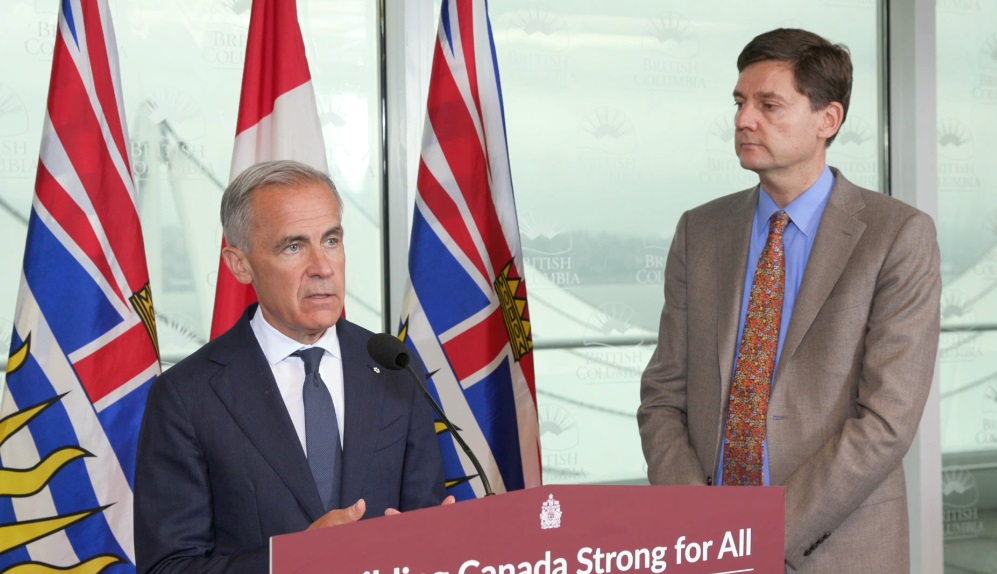
PRIME Minister Mark Carney and Premier David Eby on Thursday signed the new Canada-British Columbia Cooperative Prosperity Agreement, which will further accelerate the construction of major energy and trade corridors throughout the province, including:
- LNG Canada Phase 2, Ksi Lisims LNG, Cedar LNG, and Woodfibre LNG: The federal government will work with proponents, communities, and First Nations to accelerate the permitting, financing, and construction of these projects to boost LNG supply for Canadians and Canada’s allies.
- Red Chris Mine Expansion: $500 million investment to expand Red Chris Mine, which will increase Canada’s annual copper production by more than 15%, support critical minerals demand for clean energy and manufacturing, and reduce greenhouse gas emissions by over 70% once operational.
- North Coast Transmission Line: $3.9 billion, through various tools, toward the total capital costs of Phases 1 and 2 of this project, to deliver clean, reliable, and affordable electricity to communities across British Columbia. The project has the potential to create $10 billion in new economic activity, while reducing emissions by up to three million tonnes annually. It will become the backbone of a clean-energy corridor, including a proposed Yukon-British Columbia Grid Connect that will increase the Yukon’s energy security and affordability, as well as a potential interconnect with Alberta to optimise power reliability and sustainability in that province.
In parallel, Canada and British Columbia are building the trade infrastructure the country needs to ship Canadian energy to new markets around the world, including:
- Transforming the Port of Vancouver-Roberts Bank trade corridor: The federal government will invest in infrastructure upgrades to Roberts Bank Terminal, expanding the capacity of the Port to ship to new export markets overseas. This project will unlock over $100 billion in new trade capacity and add approximately $3 billion to Canada’s economy every year.
- George Massey Tunnel Replacement Project: Up to $3 billion to replace the aging four-lane transport tunnel along Highway 99 with a modern eight-lane tunnel. This will break down a key Lower Mainland trade bottleneck to enable British Columbia and Canada to export more of what we produce, faster – while cutting travel times for people and goods across Greater Vancouver and traffic bound for BC Ferries to Vancouver Island.
- Port of Prince Rupert and the Port of Stewart: Canada will work with port authorities and First Nations to maximise the potential of these ports to serve as vital trade corridors for Canadian goods and services, including critical minerals.
“As these ports and trade routes grow, we will also strengthen British Columbia’s maritime economy by prioritising engagement on federal vessel programs, including potential shipbuilding, servicing, and ship recycling sites on Vancouver Island and in the Lower Mainland. These projects will be built in consultation and partnership with First Nations, creating unprecedented opportunities for First Nations co-ownership and economic benefits,” reads the statement from the Prime Minister’s Office.
“Today’s agreement is underpinned by a series of historic commitments to protect and preserve Canada’s land and waters. To that end, Canada and British Columbia will establish a new National Carbon Credit Framework to build carbon markets that work. We will reinforce existing protections for Canada’s whales – including the Southern Resident Killer Whale habitat along British Columbia’s Coast – through a $250 million investment in the Whales Initiative announced in the Spring Economic Update. We will also strengthen protections for coastal ecosystems through the Oceans Protection Plan. With this agreement, the federal government commits to maintaining the federal North Coast tanker ban, in accordance with the proposed route of a new trans-provincial pipeline under the bilateral agreement between Canada and Alberta.
“Canada’s new government is building at a scale and speed not seen in generations, which will create tens of thousands of high-paying careers across British Columbia and Canada. To prepare the workforce, the federal government will recruit, train, and certify up to 100,000 new Red Seal trades workers through our Team Canada Strong initiative, and partner with unions to maximise opportunities for Canadian workers. We are also taking action to stabilise and strengthen British Columbia’s strategic sectors, including softwood lumber. This will include new measures to modernise operations, support simplified access to fibre, and expand the use of wood in construction. To help more British Columbians participate in Canada’s growing economy, we will provide over $630 million for affordable child care in British Columbia.”