JUST days before property taxes are due for millions of British Columbians, a new report from the Business Council of British Columbia (BCBC) finds that runaway growth in municipal spending continues to push property taxes higher across the province, raising questions about whether taxpayers are getting good value for money.
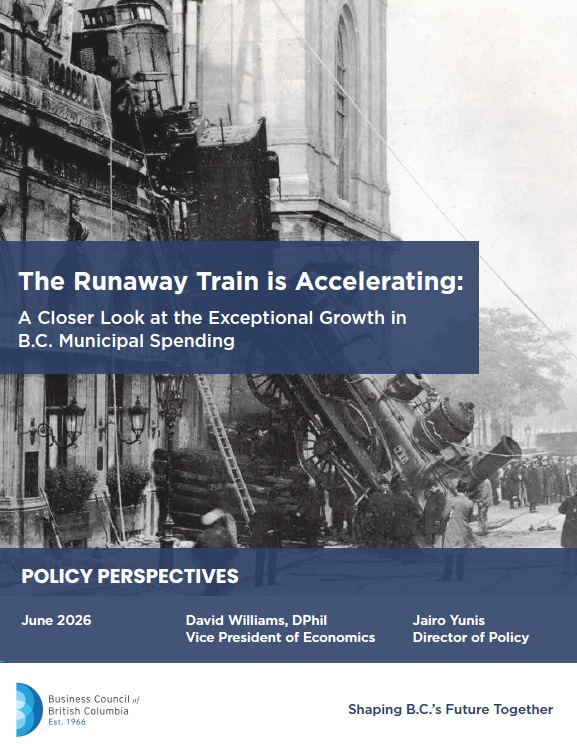
The report, The Runaway Train is Accelerating: An Updated Look at Growth in B.C. Municipal Spending, estimates that B.C. municipalities accumulated approximately $6.5 billion in excess spending—defined as spending beyond what would have been required simply to keep pace with inflation and population growth—between 2010 and 2024.
During that period, municipal operating spending across B.C. increased by 94 per cent, compared to population growth of 28 per cent and overall inflation of 36 per cent. As a result, property taxes on owner-occupied housing have climbed 110 per cent since 2010, nearly double the national average increase of 62 per cent.
To help British Columbians explore the findings, BCBC has launched the B.C. Municipal Spending Tool at BCSpending.ca. The interactive tool allows users to search any B.C. municipality and compare real operating spending growth with population growth between 2010 and 2024.
The report also examines B.C.’s largest regional district,
“Last year we warned that municipal spending growth in B.C. resembled a runaway train,” said David Williams, BCBC Vice President of Economics. “Our updated report shows the train isn’t slowing; it’s
Key findings include:
- Municipal property taxes on owner-occupied housing have increased 110% since 2010, compared to 62% nationally.
- Municipal operating spending increased 94% between 2010 and 2024, compared to 36% inflation and 28% population growth.
- 135 of 153 B.C. municipalities (88%) increased real (inflation-adjusted)
operating spending faster than population growth.
- Municipalities accumulated an estimated $6.5 billion, or $1,280 per resident, in excess spending between 2010 and 2024.
- Metro Vancouver’s operating spending increased 97% between 2010 and 2024, compared to 31% regional population growth and 36% inflation.
“Population growth and inflation naturally increase the cost of delivering municipal services,” said Jairo Yunis,
To help improve fiscal discipline, the report recommends:
- Municipal governments should anchor operating spending growth to inflation and population growth. For increases above that benchmark, the province should require councils to provide
residents with clear justifications tied to measurable service improvements or specific local costs.
- The province should expand the B.C. Auditor General’s mandate to cover municipalities and regional districts, re-establishing independent oversight that’s currently missing at the local government level.
- The province should review and reform Metro Vancouver’s governance structure and internal audit functions to strengthen accountability.
Full Report and Graphs: https://bit.ly/4evIIYa
B.C. Municipal Spending Tool: www.BCSpending.ca