


MORE than 16,000 people of South Asian heritages in British Columbia have provided input for a provincial museum that educates, preserves and celebrates the richness of Canadian South Asian histories, traditions and cultures.
“The broad participation from British Columbians of South Asian heritages demonstrated how important it is for communities to see their cultures and stories reflected and recognized in a museum,” said Anne Kang, Minister of Tourism, Arts, Culture and Sport, on Wednesday. “I want to express my gratitude to both individuals and organizations for their time and the thought put into their contributions. We heard that it’s important to these communities to protect and pass down their traditions, languages and histories through a museum. We are committed to continuing to work with these communities on next steps.”
The Province recently concluded a 12-month engagement to explore the diverse range of perspectives for a vision of a museum and then reported what are shared values and what is unique and distinctive between and within communities’ visions.
“South Asian communities have long contributed to shaping the vibrant, diverse and welcoming B.C. we know today,” said Amna Shah, parliamentary secretary for anti-racism initiatives, mental health and addictions. “As an immigrant of South Asian heritage, I know how meaningful it is to have a place where our history is preserved, celebrated and shared. I am grateful to everyone who participated on the engagement and look forward to continuing our collaboration to create a space that honours our diverse backgrounds.”
Feedback from engagement participants described a museum that serves both Canadians of South Asian heritages and those looking to learn and experience said heritages and cultures. Participants said the museum should acknowledge and celebrate the many cultures, events and holidays of Canadians of South Asian heritages and encourage community connections. Participants also noted the opportunity to increase understanding about the struggles, contributions and progress of people of multiple South Asian heritages as they have settled in the province.
The engagement included a public survey, online submissions, community-hosted conversations, youth engagement, one-on-one discussions and targeted engagement. The targeted engagement ensured a broad range of voices were captured from smaller heritage groups as well as subject-matter experts, such as academics and museum professionals. The Province provided $500,000 to help communities organize engagement sessions and report on the input. In total, 46 organizations helped to hold 145 engagement sessions.
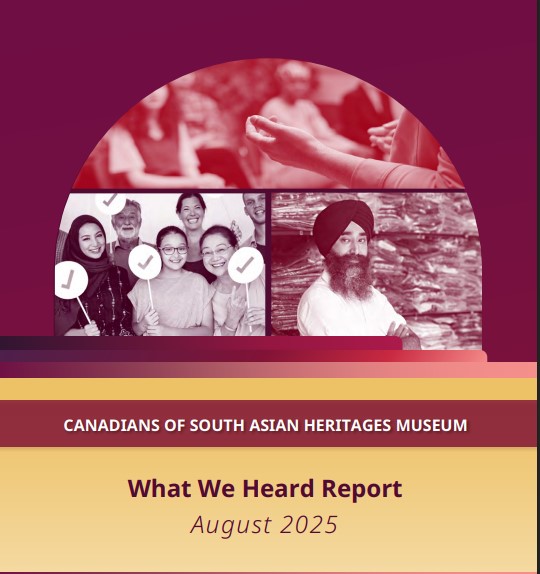
The What We Heard report reflects the visions and ideas of the community for a provincial museum. The report is available online.
While the term South Asian is globally recognized, it is not a term that all communities feel is representative or respectful, a sentiment that is getting increased support. The report includes some terms that were suggested by participants during the engagement. The term South Asian continues to be used as a placeholder only.
ACCORDING to the report, two cities were frequently noted by participants as potential locations for the museum.
It noted: “Surrey was the most suggested location for the museum. Those who favoured this location noted the high number of Canadians of South Asian heritages who live and work in Surrey, as well as the number of people that travel to Surrey to shop for South Asian groceries, cuisine, and clothing. Some participants mentioned that Surrey is a more convenient access point for surrounding cities such as Burnaby, Coquitlam and Abbotsford, than downtown Vancouver. Additionally, it was acknowledged that Surrey would offer a greater opportunity to find the necessary land required to build a museum at a lesser cost, compared to downtown Vancouver.
“Downtown Vancouver was the second most identified location for the museum due to its role as the epicentre for tourism in British Columbia, and in particular for individuals arriving via cruise ships. If a goal of the museum is to educate Canadians and international visitors about Canadian South Asian heritages in B.C., then downtown Vancouver was seen as the ideal location. Museums in other jurisdictions, such as Toronto, Ontario, are positioned in the downtown core to capitalize on the volume of traffic and tourists. Some participants did raise concerns about downtown Vancouver as a permanent location due to travel time, cost of parking, and accessibility via transit. Others mentioned that selecting Surrey as the location may feel isolating for non-South Asian heritage community members.”
Several other cities were also mentioned as potential locations for the museum.
Quick Facts:
* Canadians of South Asian heritages have origins in nations such as Bangladesh, Bhutan, India, Maldives, Nepal, Pakistan, Sri Lanka and Afghanistan, with a diaspora as far-reaching as Fiji.
* In 2017, the Province committed to explore the possibility of a museum that focused on the contributions of Canadians of South Asian heritages.
* The most recent engagement builds on the Punjabi Canadian Legacy Project (2014-2018) and the South Asian Canadian Legacy Project (2020-2022), which was led by the South Asian Studies Institute and supported through funding from government’s multiculturalism and anti-racism branch.
* Canadians of South Asian heritages make up about 9.6% of the population and are the second largest racialized group in B.C. (source: 2021 Census of Population)
Learn More:
To read the What We Heard report, visit