



FEDERAL Finance Minister François-Philippe Champagne tabled his first budget in the House of Commons, saying “This budget must be generational in its ambition and serve to shape our economy and our nation’s future.”
THE federal government says it is building One Canadian Economy turbo-charged by major nation-building projects that will connect our regions, diversify our markets, and create hundreds of thousands of high-paying careers, from the skilled trades to advanced technology.
Canada must build an enormous amount of infrastructure at speeds and scale not seen in generations.
This includes the infrastructure to diversify our trading relationships, to become an energy superpower in both clean and conventional energies, to restore affordability to housing, and to secure our borders and our communities.
Just as the railways united our country, the Trans-Canada Highway opened our frontiers, and the St. Lawrence Seaway linked our economy to the world, today’s projects will be as transformative—building clean power grids for a sustainable future, expanding our ports to accelerate our trade, and unlocking the full potential of Canada’s critical minerals, says the government.
It adds: “We are strengthening the economic foundations of our nation, giving our workers, innovators, and businesses the tools they need to compete, create, and lead in a changing world.”
- Fast-tracking nation-building projects: In close partnership with provinces, territories, Indigenous Peoples, and private investors the government is streamlining regulatory approvals and helping to structure financing.
- Competing and winning abroad: To seize new opportunities in a changing world, Canada is launching a new Trade Diversification Strategy to boost our global footprint. Building on our world-class agreements and partnerships, this strategy will double overseas exports over a decade, generating $300 billion more in trade. Through a new Trade Diversification Corridors Fund, we will improve access to overseas markets by investing in new port, airport, and railway infrastructure. And we are providing Canadian businesses with the tools and expertise they need to succeed abroad. Canada will be a fast, reliable, and indispensable global partner.
- Becoming our own best customer: Our new Buy Canadian Policy will ensure public dollars will be used to strengthen our supply chains, and support homegrown innovation. When the government spends, we will select Canadian suppliers by default, wherever possible. By launching our Defence Industrial Strategy, we will grow our defence sector, increasing the capacity and competitiveness of homegrown defence suppliers.
- Investing in defence and security: Our government is making a generational investment in defence that will create good, high-paying careers for Canadians, and strengthen our economy and collective resilience.
- Driving growth and innovation: Our government will make it cheaper for Canadian companies to invest through a new productivity super-deduction. We will invest in AI projects to further the technology’s adoption at home, and catalyse private sector investment in Canada’s most innovative startups. The government is also developing a new AI strategy, and will consider whether new AI incentives and supports should be provided. We are creating the right conditions for real, sustainable growth.
- Powering a clean economy: Through Canada’s new Climate Competitiveness Strategy, we are strengthening Canadian leadership in a low-carbon economy. With the Clean Economy Investment Tax Credits, we will supercharge affordable, net-zero energy projects that turn our natural wealth into lasting prosperity while protecting the planet. Canada will build for the future, leveraging nuclear, solar, wind, clean hydrogen, and other renewable energy.
- Protecting our strength:A Strategic Response Fund to realign producers to serve the Canadian market and reach new markets globally, coupled with a major reskilling effort, will help tens of thousands of workers and key sectors—from canola to lumber to steel and aluminum and our auto sector—stay competitive and resilient in a shifting global economy.
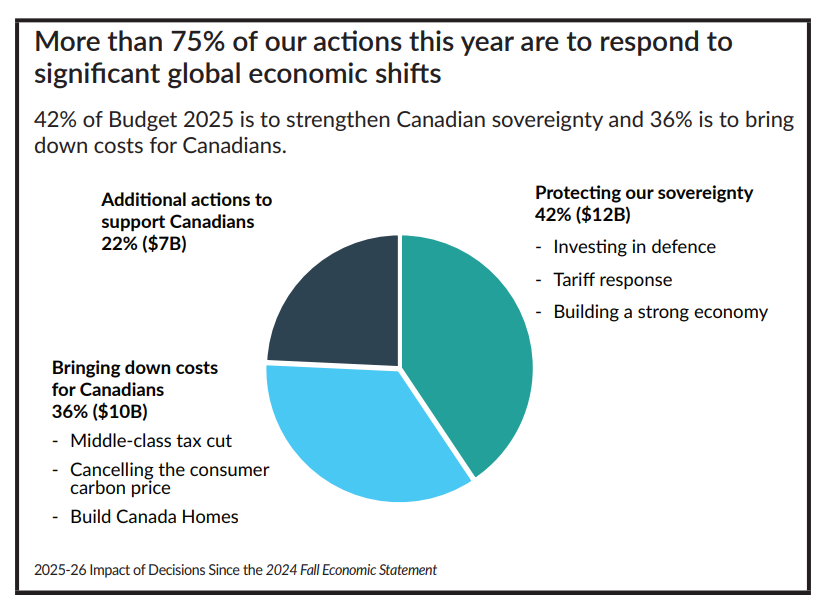
THE government says that Budget 2025 will spend less on government operations and cut waste, so it can invest more in growing our economy and protecting essential programs that make life more affordable.
It says it has been focused on bringing down costs and creating new opportunities for Canadians. It has:
- Cancelled the divisive consumer carbon price, cutting gas prices by approximately 18¢ per litre in most provinces and territories.
- Cut taxes for 22 million middle-class Canadians, saving a two-income family up to $840 per year.
- Created opportunities for young Canadians to transition into the workforce and launch successful careers, by launching a Youth Climate Corps, and providing 175,000 placements through Canada Summer Jobs, the horizontal Youth Employment and Skills Strategy, and the Student Work Placement Program in 2026-27.
- Made the National School Food Program permanent to provide meals to up to 400,000 children every year, allowing participating families with two children to save an average of $800 per year.
- Begun the process to launch Automatic Federal Benefits that will reach up to 5.5 million low-income Canadians for the 2028 tax year to ensure everyone who deserves benefits receives them.
- Renewed the Canada Strong Pass, helping families and young people travel and explore Canada for less.
- Reduced Confederation Bridge and interprovincial ferry fares in Atlantic Canada—leading to a 25 per cent increase in usage of these services for visitors leaving Prince Edward Island in August, compared with the previous year.
- Upheld the Canadian Radio-television and Telecommunications Commission decision to expand wholesale access, boosting competition and lowering Internet costs for Canadians.
A more affordable Canada also means a more competitive one. Budget 2025 will include early, but meaningful, measures to increase competition and drive down costs in key sectors such as telecommunications and banking. The government will continue to push for more choice for Canadians across the economy.