

THE B.C. Conservatives hold a narrow three-point lead over the B.C. NDP, 46 per cent to 43 per cent, a margin that amounts to a statistical tie after the New Democrats clawed back support following a rocky start to the campaign, according to the non-profit Angus Reid Institute.
The Angus Reid Institute conducted an online survey from October 15-19 among a randomized sample of 793 British Columbian adults. The margin of error of +/- 3 percentage points, 19 times out of 20.
Three-quarters of BC Conservative voters say they’re very certain in their support (73%), compared to closer to half of BC NDP voters (54%). Further, 89 per cent of 2024 Conservatives say they’re supporting the party again, while the proportion of 2024 BC NDP voters returning to the fold drops to 74 per cent.
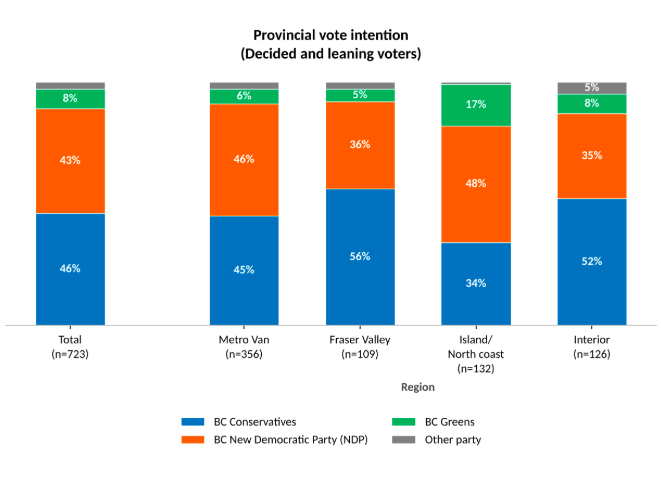
The Metro Vancouver region is a tight race, with the BC NDP (46%) and the BC Conservatives (45%) statistically tied. In 2024, the BC NDP carried that region by 10 points.
The Conservatives hold a decided advantage in Fraser Valley (+20 over second place BC NDP) and the Interior (+17), while the BC NDP perform best on the Island and North Coast (+14 over second place BC Conservatives).
The BC Conservatives are the majority choice for men older than 34 while women that age are more likely to support the BC NDP.
The Greens perform best among British Columbians under the age of 35.
The BC NDP (74% staying with party) are facing more of a challenge to retain their 2024 voters than the BC Conservatives (89%). The one-quarter of BC NDP voters who voted the party in 2024 but aren’t supporting the party now are split between moving to the Greens (8%), the Conservatives (7%), and undecided (7%). Comparatively, one-in-10 (11%) BC Conservatives are supporting another party from 2024.
NDP leader David Eby has garnered little increase in favour as the campaign has worn on. His favourability now sits three-points higher than that registered in the last week of September (36% vs 33%). His net favourability sits at minus 24. For his debate stage counterparts, awareness has grown and positive assessments have improved.
BC Conservative leader Lorne Doerkson has seen his favourability increase from 25 to 39 per cent over that period, though his unfavourable views outpace the favourable ones (-6 overall). Green Party leader Emily Lowan is viewed favourably by 44 per cent and unfavourable by 34, leaving her with a plus 10 net score.
Asked how their opinions of each leader have changed over the past week, which includes the leaders’ debate, the reviews for David Eby are poor. Half overall, and one-quarter of 2024 BC NDP voters, say their opinion of him has worsened, while few say it has improved.
For Lorne Doerkson, the improvement in opinion among his party’s 2024 voters is significant. Half say their view of him has improved. Overall, British Columbians are equally likely to feel better (25%) or worse (25%) about him this week compared to last.
On the question of which party leader would be best to serve as premier (among the two with the likeliest chance of having that opportunity) there is a three-way logjam between Doerkson (36%), Eby (34%), and neither of them (30%). Notably three-in-10 past BC NDP voters (30%) choose “neither”, as do one-in-five past Conservatives (18%).