

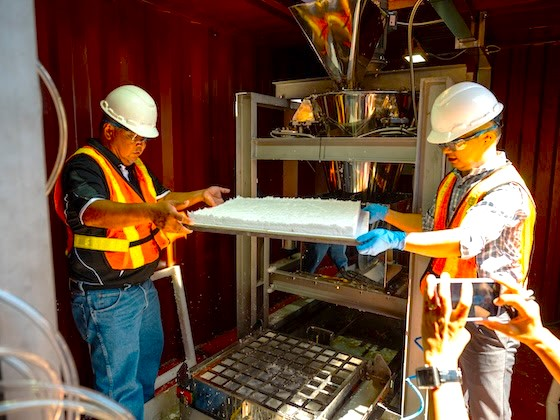
INSIDE a new facility at Main Street and Terminal Avenue in Vancouver, wood fibre is moving through a production line and emerging, transformed, as a block of lightweight “wood foam.”
For Dr. Feng Jiang, who first developed the material in his laboratory at the University of British Columbia, the moment is years in the making.
For Reg Ogen, president and CEO of Yinka Dene Economic Development Limited Partnership (YLP) and a leader of the Wet’suwet’en First Nation, it signals a shift in the Canadian bioeconomy: a new economic relationship between Indigenous communities and the forests they have stewarded for generations.
Millions of tonnes of plastic foam packaging end up in landfills each year, where they can persist for more than 500 years. This new facility aims to change that. By transforming wood waste resulting from logging or forest fires—material that might otherwise be burned or discarded—into biodegradable packaging and insulation, the partnership is turning a costly liability for the forestry sector into a high-value, sustainable product.
The pilot plant is operated by DicinFoam, a majority-owned subsidiary of YLP, the business arm of the Wet’suwet’en First Nation. Dicin (pronounced DIH-chun), the Wet’suwet’en word for wood, reflects the company’s connection to both the forest and Wet’suwet’en culture. The underlying intellectual property is co-owned by UBC and YLP.
“This partnership is a blueprint for the future of the forestry industry,” said Ogen. “Today’s forestry industrialization models have extracted value from all forest dwellers, communities, and our Indigenous cultures. Our project will maximize utilization to add value and respect to each harvested tree and land. Our wood-based biodegradable foam products will help protect Mother Earth for future generations.”
The plant converts softwoods such as spruce, pine and fir into a lightweight wood foam using heat, mechanical processing and minimal chemical additives. In packaging applications, the material is designed to break down in soil within months. The facility also produces insulation panels treated to meet building performance requirements, a market that currently relies heavily on imported wood-based products.
The technology originated in the lab of Dr. Jiang, a professor in UBC’s faculty of forestry and environmental stewardship whose research focuses on turning underused forest biomass into high-value bio-based materials. His lab continues to support DicinFoam’s scale-up, testing new feedstock combinations and expanding the range of applications as the company grows.
“With this pilot we’re creating opportunities to train the next generation of talent, including Indigenous students, in sustainable materials development and business,” said Dr. Jiang. “This will help to build a stronger and more inclusive Canadian bioeconomy.”
The bridge between lab and plant is Dr. Yeling Zhu, DicinFoam’s chief technology officer. Dr. Zhu completed his postdoctoral research in Dr. Jiang’s lab before joining another company, but when the opportunity came to return and lead the scale-up, he took it.
“As an inventor, it is rewarding to see green technologies move from the lab into pilot-scale production,” said Dr. Zhu. “Now we can prove performance, validate the process and begin building the market for a made-in-B.C. material.”
The plant currently produces 150 to 200 kilograms of wood foam per day, allowing potential customers to test the material and evaluate its performance. The company shares the site with Plantee, a manufacturer of wood-based construction materials, whose industrial expertise is helping inform the scale-up.
The next phase targets an annual capacity of 1,000 tonnes of biodegradable foam per year at a larger facility in Burns Lake, located within Wet’suwet’en territory. This expansion will anchor a forest-based innovation hub and is expected to create up to 15 jobs in a rural community, plus an additional 35 to 60 after a planned move into a larger, 15,000-tonne facility on Vancouver Island.
Two members of Huu-ay-aht First Nation on Vancouver Island — William Dennis and Shaun Dennis — are currently training at the Vancouver plant to support future operations close to home.
“This opportunity has been very meaningful to me. A company is working alongside our Indigenous band and invited me to be part of that journey,” said William Dennis. “Since then, I’ve seen how partnerships like this can create real opportunities for Indigenous people and communities. One of the things I’m most proud of is working alongside my younger brother, Shaun Dennis. I hope our involvement encourages greater Indigenous participation in clean technology and shows how collaboration can create lasting benefits for our communities and future generations.”
The project received support from Innovation UBC and funding from Natural Resources Canada’s Indigenous Forestry Initiative and its Investments in Forestry Industry Transformation, the B.C. Ministry of Forests, the B.C. Ministry of Jobs and Economic Growth, Forestry Innovation Investment and Mitacs.