
Clear decline of Conservative fortunes in seat-rich Ontario
THE political landscape is now clearly shifting in favour of the Liberals and to the detriment of the Conservatives. The Scheer-led Conservatives have seen their 11-point lead from just a month ago shrink to a narrow 2.7-point lead as of June 16.
The results Ekos Politics’ most recent three-day poll (n=1,229) are: 33.6 per cent for the Conservatives, 30.9 per cent for the Liberals, 13.6 per cent for the Greens, and 11.9 per cent for the NDP.
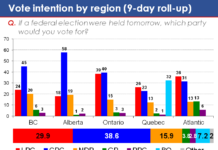
For the purpose of ensuring a more reliable analysis of regional and demographic patterns, Ekos Politics also presents a six-day roll (n=2,491), which shows a four-point lead for the Conservatives. These results, coupled with the three-day roll, suggest that the recent trend of inverse fortunes for the Liberals and Conservatives is continuing.
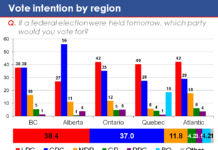
The most notable feature of the political landscape is the clear decline of Conservative fortunes in seat-rich Ontario and the corresponding rise of the Liberals. In their internal polling, Ekos Politics found that this pattern is clearly linked to declining confidence in Doug Ford’s Progressive Conservative government.
The Conservatives continue to enjoy a large advantage with men, while the Liberals have a
modest advantage with women. The Conservatives have a large advantage with working class and non-university educated voters, which is critical to their constituency and different than in 2015. Regionally, the only clear results outside of Ontario are the prairies, which look to be an overwhelming Conservative advantage. British Columbia, Quebec, and the Atlantic look to be a confused and unclear mix of support.
Using their internal seat projections, Ekos Politics has the Liberals holding a razor-thin advantage of 150 seats versus 143 for the Conservatives. The Green Party, which received just three per cent and a single seat in the last election, is now at 14 points and looking at capturing 12 seats should these numbers hold. This number will become particularly interesting if the combined Liberal and Green numbers surpass a majority of the seats. The NDP is struggling at just 14 seats. Any further erosion could move them out of official party status and into rump territory.
It is important to note that seat projections at this stage, while anecdotally interesting, have little value in terms of the October election. The election is still four months away and a great deal can happen in that time.
Bottom line: the October election is going to be an extremely tight contest with no clarity as to who will be the winner. At this stage, the most likely scenario is some form of minority government.
This report discusses findings from two roll-ups of the same poll. The field dates for the three-day roll-up are June 14-16, 2019. In total, a random sample of 1,229 Canadian adults aged 18 and over responded to the survey. The margin of error associated with the total sample is +/-2.8 percentage points, 19 times out of 20.
The field dates for the six-day roll-up are June 12-17, 2019. In total, a random sample of 2,491 Canadian adults aged 18 and over responded to the survey. The margin of error associated with the total sample is +/- 2.0 percentage points, 19 times out of 20.