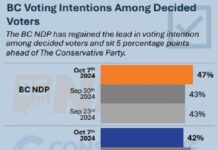


A Leger poll shows that among decided voters in British Columbia, 39% support the Conservative Party of BC and 36% the BC NDP, followed by the Greens at 13%, OneBC at 5% and CentreBC at 5%.
However, 28% say they are likely to switch their vote, rising to 41% among residents aged 18 to 34.
Also, 57% disapprove of the decision to hold an early election, while 28% approve.
David Eby is the preferred choice for premier among 39% of BC residents, compared with 35% for Conservative interim leader Lorne Doerkson.
Some NDP support appears to come from voters who are dissatisfied with the government but remain unconvinced by the alternatives.
Overall, 42% of BC residents say the NDP should be re-elected. But only 19% say David Eby and the NDP have done a good job governing and deserve another term. Another 22% say the government has done a poor job but still consider it the best choice.
The Conservatives face their own challenge as 57% of BC residents are concerned that some Conservative MLAs and candidates hold views, they consider too extreme. More than half also express doubts about the credibility of the party’s current leadership or say recent internal divisions make them less likely to vote Conservative.
The poll found that 60% say the Conservatives’ recent disagreements matter less to them than the major issues facing the province, and that rises to 66% among voters who say they could switch parties. Among those moveable voters, 50% also say voting out the NDP matters more to them than the Conservatives’ recent problems.
Regarding issues that matter most to British Columbians, health care now ranks first, with 15% naming it as the most important issue facing British Columbia. Housing prices and affordability follow at 14%, with the economy close behind at 13%. (In August 2024, 27% of BC residents identified housing affordability as the province’s most important issue. Today, that figure is 14%.)
Housing remains especially important to younger British Columbians, while health care becomes more prominent among older residents. Priorities also vary by party support: NDP voters place more emphasis on health care, Conservative voters on the economy and taxes, and Green voters on housing affordability.
There is no single issue defining this campaign. What matters most depends heavily on who you ask, says Leger.
This online survey was conducted from September 24 to 28 among 1,003 British Columbia residents aged 18 or older, randomly recruited through Leger’s LEO online panel. Results were weighted according to age, gender, region and education to ensure a representative sample of the population of British Columbia. A margin of error cannot be associated with a non-probability sample. For comparison purposes, a probability sample of 1,003 respondents would have a margin of error of no greater than ±3.1 percentage points, 19 times out of 20.