


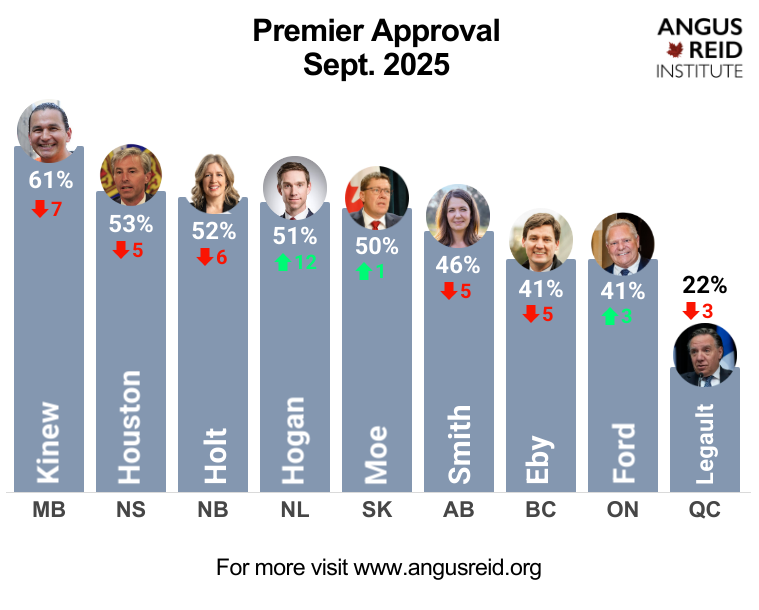
THE downward trend for British Columbia Premier David Eby continues as two-in-five (41%) say they approve of his performance, the lowest rating he’s received since he took office. His approval has now fallen for two straight quarters, according to new data from the non-profit Angus Reid Institute.
Eby announced that the province was “facing big fiscal headwinds”, including a potential $10-billion deficit, as it works to end a strike by the B.C. General Employees’ Union (BCGEU). Provincial government spending under Eby has severely outpaced that of his predecessor John Horgan; the province’s debt is forecast to nearly double in the next three years.
The government also faced public outrage from a decision by the Expensive Drugs for Rare Disease committee which ruled to stop providing a drug for a terminally-ill 10-year-old B.C. girl suffering from Batten disease. Eby and Health Minister Josie Osborne initially said they wouldn’t overturn the ruling, but reversed course after receiving a letter from experts who study the disease.
IN Quebec, once the most popular premier in the country, Premier François Legault is now far and away the most unpopular.
One-in-five (22%) in Quebec approve of Legault, while more than three times as many (72%) do not. This marks the lowest approval of Legault since he first took office in 2018, and a remarkable reversal of fortunes for a leader who secured back-to-back majorities in 2018 and 2022. He now stares down “disastrous defeat”.
The ongoing public inquiry into the SAAQclic $500-million overspend has evidently not done Legault any favours, as he’s been skewered for admitting ignorance to the project’s ballooning budget.
Legault and his Coalition Avenir Quebec have 13 months to right the ship before the province’s scheduled election.
The country’s next provincial election will feature one of its most recent additions to the ranks of premier, Newfoundland and Labrador’ John Hogan. After being sworn into the job in May, Hogan and his governing Liberal Party face an election in October. Half (51%) approve of his performance so far, a 12-point increase from last quarter when many were reserving judgement.
ONTARIO Premier Doug Ford finds himself once again near the bottom of the quarterly premier approval rankings, but he does so with an approval of 41 per cent, a figure he has been able to match or eclipse only three times since Sept. 2022.
Ford continues to mix things up on the tariff front, issuing sharp words to the owner of a Hamilton steel plant and the makers of Crown Royal, dumping a bottle of the whiskey after the company announced it was relocating jobs from Ontario to the U.S. His fiery responses to revelations on medical tests on dogs in the province – “stop before I catch you” – and a nationally viral story about a man who was charged with assault after he fought with an intruder who broke into his home – “something is broken” – perhaps resonate with some in the province.
Meanwhile, the province’s economy is suffering from the tariffs, losing 38,000 jobs in the second quarter of 2025. Unemployment is also higher than it has been since 2012, excluding the pandemic. Ford’s government has been criticized for slow implementation of the “Protect Ontario Account” designed to help companies hit by tariffs.
ALBERTA Premier Danielle Smith continues to be the most polarizing premier in the country. One-quarter (24%) strongly approve of her performance – the most in the country and ahead of Manitoba’s Wab Kinew (22%) this term. But two-in-five (40%) strongly disapprove of Smith, the second highest behind Quebec’s François Legault (49%). This month, Smith’s approval returns to familiar territory, with 46 per cent in the province offering her a thumbs’ up.
Smith has not been afraid to institute controversial policies that both play to her party’s right flank and generate loud criticism from elsewhere in the province. A ministerial order banned books with sexually explicit written, illustrated or audio content from Alberta schools right before the school year. The government went back to the drawing board after the Edmonton Public School board released a list of books it was removing that included classics such as Margaret Atwood’s The Handmaid’s Tale. Smith’s government has been criticized for its censorship and for leaning heavily on American sources to guide them on which books to ban.
The province also became the first to charge most of its residents for COVID-19 immunization, which doctors criticized for its potential to create inequalities in coverage between rich and poor residents. The Alberta government argues paying for the vaccines – which were previously funded by the federal government – would require diverting money from other areas of the health-care system and that many free vaccines went to waste last year.