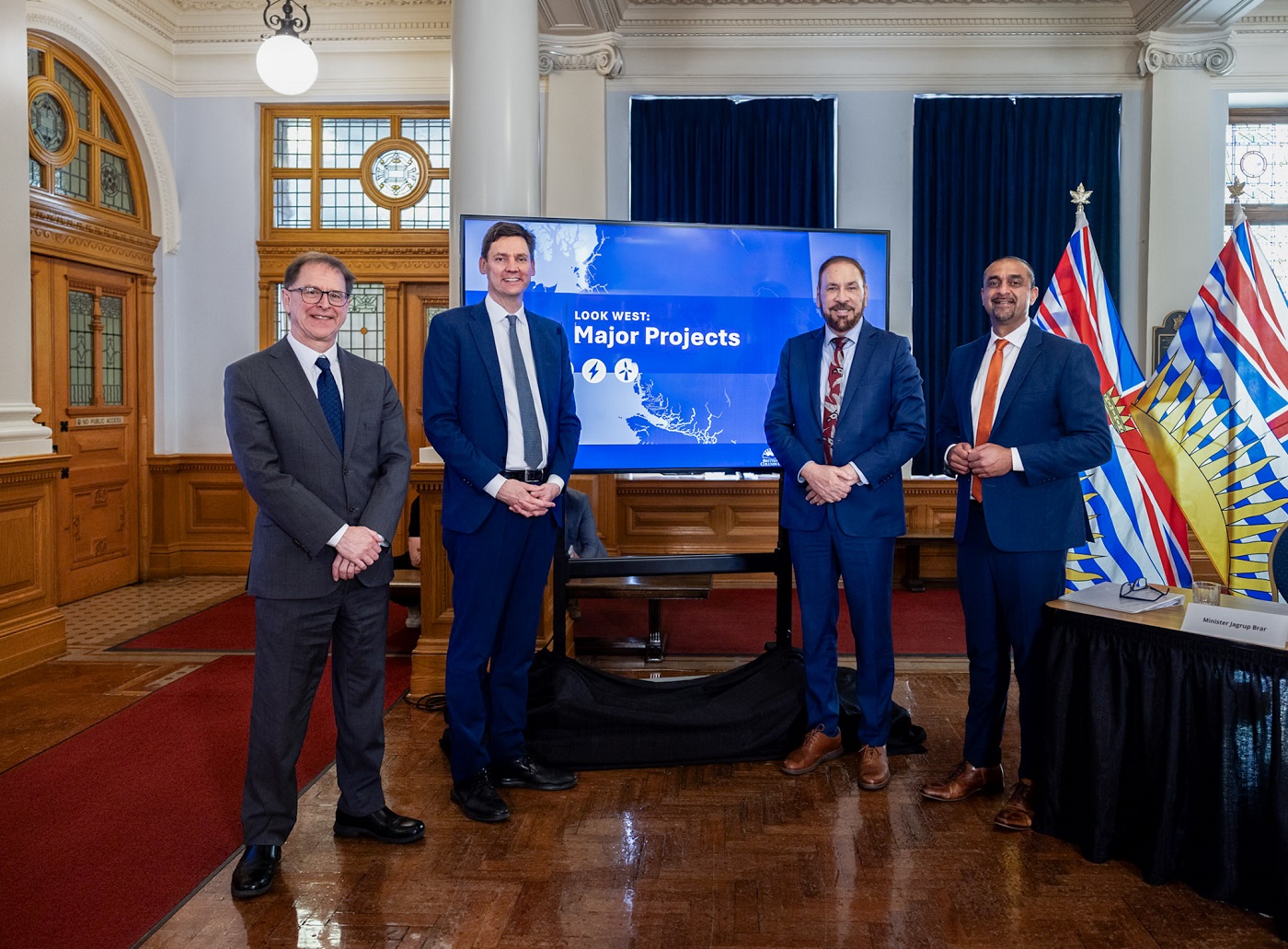
THE provincial government on Wednesday said that eighty-eight billion dollars worth of proposed major project investments are estimated to create tens of thousands of jobs in B.C. communities over the next three years. It added that this demonstrates the progress it is making to grow B.C.’s economy through the Look West strategy.
To continue accelerating economic growth, the government is adding 17 new major projects to the list of priority projects, nearly double the previous number, as another step toward becoming a more independent economy that’s less reliant on a single trading partner.
“At a time when countries around the world are looking for responsibly developed resources and stable trading partners, this is British Columbia’s moment,” said Premier David Eby. “Through our Look West plan, we’re leveraging our strengths here to get major projects built, create good jobs, and invest in skills training so people can step into these opportunities and earn bigger paycheques. This is how we create long-term prosperity to support the public services that make us all better off.”
Look West was launched in November 2025 as a targeted plan designed to deliver major projects, strengthen B.C.’s and Canada’s economic security in the face of economic threats, and create good jobs and opportunities for people to train for careers in the skilled trades.
It includes a goal to secure $200 billion in investment by 2035 for major projects in B.C., and a commitment of $241 million over three years to double trades training funding and permanently strengthen and expand B.C.’s trades training system.
“The global uncertainty from U.S. tariffs and the war in Iran are having real impacts on people and businesses, but we’re not backing down or waiting,” said Ravi Kahlon, Minister of Jobs and Economic Growth. “Forty per cent of the federal government’s priority major projects are right here in B.C., and we believe there should be more. That’s why we’ll be submitting this new list of projects to the Government of Canada, so we can keep working together to grow a strong, national economy that can stand on its own.”
By speeding up permitting while also recognizing the importance of Indigenous engagement and strong environmental stewardship, major mines and energy projects are moving faster and will provide new opportunities and good jobs for people, and significant revenue to the Province that will help pay for the schools, hospitals, police and transportation infrastructure that people in B.C. rely on.
This includes the Phase 2 expansion of the Blackwater gold and silver mine, a $1.44-billion investment, which is anticipated to create 1,500 construction jobs and an additional 300 operational jobs, bringing total employment to 1,200 permanent operations positions, and could generate an estimated $2 billion in mineral tax over the multi-decade life of the mine.
This is one of the projects that is now included in the Province’s list of priority major projects to support their progress.
Clean energy is B.C.’s superpower and the Province is taking action to boost electricity supply needed to power communities and major industrial developments throughout the province.
The Province has passed regulations to make the BC Energy Regulator the primary regulator for renewable energy projects, including wind and solar power, as well as major transmission infrastructure such as BC Hydro’s North Coast Transmission Line (NCTL). The immediate benefit of this change will be streamlined and expedited permitting for BC Hydro’s 2024 call for power projects. These 10 wind and solar projects represent approximately $6 billion in private-sector investment. Combined, the clean-energy projects are expected to create approximately 2,000 jobs annually during construction and will generate nearly 5,000 GWh per year, boosting B.C.’s electricity supply by 8% – enough energy to power approximately 500,000 homes.
One of these projects is the sniwt iʔ k̓ʷul̓mntn Wind Project, which is majority owned by the Upper Nicola Band and being developed in partnership with Elemental Energy. This 94-megawatt wind farm will be located between Merritt and Kelowna. The project is targeting construction in spring 2027. Once operational, the project will produce enough clean electricity to power approximately 25,000 average homes each year.
In 2025, the Province and BC Hydro launched a second call for power, which is targeting an additional 5,000 GWh annually. Projects resulting from the 2025 call will be announced this spring.
B.C.’s North is experiencing historic growth, and to ensure that enough clean energy is available to power new mines, energy projects and communities in northwestern B.C., the Province has taken action to support the North Coast Transmission Line (NCTL).
Through the Energy Statutes Amendment Act, the Province has created legislative tools to advance the project and enable First Nations ownership participation, while related regulatory actions are designed to help major industrial customers connect and move toward final investment decisions.
Building the NCTL is a cornerstone of government’s co-ordinated strategy to meet the rising demand for clean electricity and to power economic growth, jobs, climate action and reconciliation throughout British Columbia. Construction on the NCTL is expected to begin this summer.
The government said that as global conflicts and uncertainty continue to impact resource supply chains worldwide, moving natural gas projects forward quicker is critical to ensuring Canada plays a leading role in global energy markets.
Cedar LNG, a $4.7-billion private-sector investment and the largest Indigenous majority-owned infrastructure project in Canada, is well underway. It will create as many as 500 construction jobs and 100 long-term operational jobs and is expected to be complete in 2028.
The Government of Canada also recently approved the Sunrise expansion program, a $4-billion expansion of Enbridge’s pipeline network. This will allow more natural gas to reach international markets from B.C. while creating 2,500 jobs during construction and significant revenue for the Province.
In addition, approximately $50 billion worth of final investment decisions are expected this year or early next year, including Phase 2 of LNG Canada, which would be the largest private-sector investment in Canada’s history, as well as the Ksi Lisims LNG and Prince Rupert Gas Transmission projects, a partnership between the Nisga’a Nation, Western LNG and Rockies LNG.
An all-of-government approach is underway to speed up approvals, reduce duplication, remove barriers and simplify processes so projects can move more quickly from proposal to construction.
As part of that work, several priority projects have received permitting needed to proceed, including the Eskay Creek mine, the Copper Mountain mine’s New Ingerbelle expansion and Mount Milligan mine’s 2035 extension.
The Province is also developing an expedited major projects environmental assessment process to help get priority projects reviewed and built quicker.
Since Look West was launched, five major mines have been permitted:
* Quintette coal mine – $500 million
* Highland Valley Copper extension – $2.25 billion
* Mount Milligan mine extension – $400 million
* Eskay Creek mine – $713 million
* Copper Mountain mine expansion – $290 million
Since the 18 priority major projects were announced, Eskay Creek and the Mount Milligan and Highland Valley Copper mine extensions have all been approved by the Province.
Since launching Look West, the Province has advanced the strategic plan’s short-term goals, including prioritizing major projects, speeding up permitting, supporting clean and low-carbon energy infrastructure, strengthening interprovincial trade, creating a new $400-million B.C. Strategic Investment Fund, and growing innovation and defence-related opportunities in B.C.
Six months since it was launched, Look West is delivering real results: bringing investment certainty, accelerating construction, and creating good-paying jobs in communities throughout British Columbia while strengthening Canada’s long-term economic security.
Quotes:
Adrian Dix, Minister of Energy and Climate Solutions –
“With over $50 billion worth of final investment decisions expected this year or early next year, B.C. is well-positioned to be the energy engine of Canada. We have the projects, we have the resources and we have the skilled workers to get these developments online and shipping products quickly. It’s clear that when the world is looking for energy they are looking west to B.C. to fill their demands.”
Jagrup Brar, Minister of Mining and Critical Minerals, said: “With record investment numbers last year, more than 1,000 global mining and exploration companies headquartered in B.C., and growing interest from the world’s top producers like Anglo and Teck, our province is leading the future of responsible resource development. Through Look West, we are turning that momentum into action, delivering permits for priority projects, accelerating critical minerals development and reinforcing British Columbia’s position as a globally competitive, trusted destination for investment, jobs and meaningful reconciliation.”
Jessie Sunner, Minister of Post-Secondary Education and Future Skills, said: “These major projects are being built by skilled tradespeople and will drive our economy for generations. Our government is putting British Columbians first by investing $241 million to open up to 5,000 new trades training seats in the next year, so British Columbians across our province can build these projects and secure good-paying jobs right here at home. This investment builds on the $3.2 billion we invest every year to strengthen our public post-secondary sector, which directly supports Look West priority careers.”
Quick Facts:
* Since 2017, B.C. has been an economic leader in Canada with the most GDP growth of large provinces, the highest capital investment growth per capita, the highest real median income growth, and the highest wage growth.
* According to Statistics Canada, B.C. has added more than 10,000 construction jobs in the past year and has the fastest retail sales growth in Canada.
* From December 2024 until December 2025, B.C. had the second-highest growth in active businesses in the country.
* In 2025, B.C.’s mining exploration sector saw $751 million in investment, a 36% increase from 2024 and the highest ever in the province.
* By the end of this decade, British Columbia is expected to export 19.4 million tonnes of LNG per year, making B.C. the sixth-largest exporting jurisdiction globally based on current export volumes.
* Once operational, additional LNG projects in the 2030s could increase that to 47.9 million tonnes annually, making B.C. the fourth-largest LNG exporter in the world.
Learn More:
* Read the full Look West: Jobs and Prosperity for a Stronger B.C. and Canada strategy here: https://gov.bc.ca/LookWest